

Are you interested in expanding into large-scale production of non-alcoholic beverages? Kvass is one of the smartest and most accessible ways to enter the category right now.
A Modern, Simplified Production Method
Here you’ll find a streamlined, industrial approach to producing non-alcoholic kvass that delivers authentic flavor without the complexity of traditional fermentation. Built on malt extracts and precise process control, this method allows you to create a consistent, high-quality product while keeping alcohol levels safely at ≤0.05% ABV.
Enhance Authenticity with Rye Revived Malt Extract
For an even more authentic kvass profile, consider using our Rye Revived malt extract in your production. It is made from surplus bread, just like traditional kvass, giving your final product a deeper, more genuine flavor. This not only improves taste authenticity but also adds a compelling sustainability story to your product.
Simple, Scalable, and Reliable
What makes this approach especially powerful is how simple and scalable it is. There’s no risk of unintended alcohol formation, no need for fermentation tanks or yeast management, and no variability between batches.
Fast Production and Long Shelf Life
Production is also fast and predictable. You can go from raw materials to finished product in just a few hours. Pasteurization ensures strong microbiological stability and a long shelf life, making distribution straightforward. The recipe also supports clean-label positioning with a short ingredient list, while still delivering the rich, refreshing kvass taste consumers expect.
Here’s the recipe:
NON ALCOHOLIC KVASS (≤0.05% ABV) — INDUSTRIAL PROCESS
Batch Size Example: 10,000 L finished beverage
Base: 100% malt extract / rye malt extract
1. Product Targets
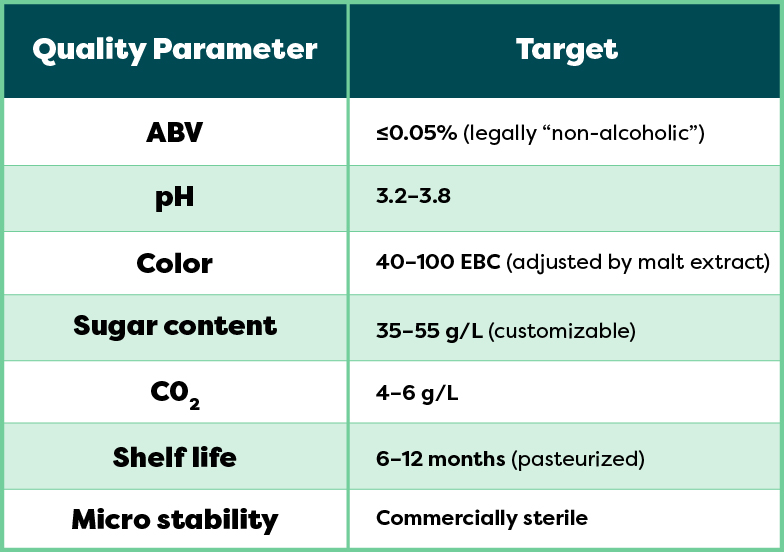
Goal: Achieve kvass flavor without fermentation, to eliminate alcohol.
2. Ingredients (per 10,000 L)
Core base
1. Dark liquid malt extract (LME): 240–360 kg
2. Rye Revived malt extract (recommended for authentic kvass): 60–120 kg
Acidification
3. Food grade lactic acid (80–90%): ~1.5–3.5 L (to reach pH 3.2–3.8)
Sweetening
4. Sugar syrup (60–65 Brix) or dry sugar: 120–220 kg, depending on sweetness target.
Water
5. Purified water to 10,000 L.
3. Process Overview
Key principle:
NO fermentation is performed. Flavor is created using extracts + acidification + optional natural kvass flavor. Alcohol formation is therefore zero.
4. Detailed Manufacturing Steps
STEP 1 — Dissolving the Malt Extract
Equipment: Mixing tank with agitation & heating.
1. Heat water to 55–65°C.
2. Add dark LME gradually.
3. Add rye malt extract.
4. Mix thoroughly until uniform.
Target gravity: 4.0–6.0 °P (adjust by adding sugar syrup).
No fermentation → °P is purely a sweetness/body target.
STEP 2 — Thermal Treatment (Microbial Safety)
Choose one of the following:
Option A: Flash pasteurize, 72–75°C for 20–30 sec
Option B: Short boil, 95–98°C for 5–10 minutes
Purpose:
• Sterilize the base
• Remove microbial load
• Improve shelf life and stability
After heat treatment, cool to 20–30°C.
STEP 3 — Acidification (Kvass Tang Without Fermentation)
Add lactic acid slowly to reach:Final pH target: 3.2–3.8
STEP 4 — Flavor Tuning (Non-Alcoholic Profile)
Make adjustments
Mandatory:
• pH
• Sweetness (post-pasteurization syrup addition gives better control)
Optional:
• Black extract for color and slight bitter edge
• CO₂ level determines perceived acidity/sweetness
STEP 5 — Filtration (for clarity & stability)
Recommended steps:
1. Plate & frame → 1–2 µm
2. Polish filtration → 0.45 µm (if very long shelf life desired)
This is a non-fermented beverage → filtration keeps stability high.
STEP 6 — Carbonation
Carbonate in BBT:
• 4–6 g/L CO₂
• Equivalent ≈ 1.8–2.5 volumes CO₂
Higher carbonation = crisper kvass character.
STEP 7 — Final Pasteurization & Packaging
For long shelf life (recommended)
• Tunnel or flash pasteurization
• 15–30 PU depending sweetness & package
Packaging options
• PET
• Glass
• Can
• Keg (for draft)
Oxygen control
• Target <100 ppb TPO
• Protects flavor and color.
5. Detailed Formulation Example (NON ALC KVASS 10,000 L)
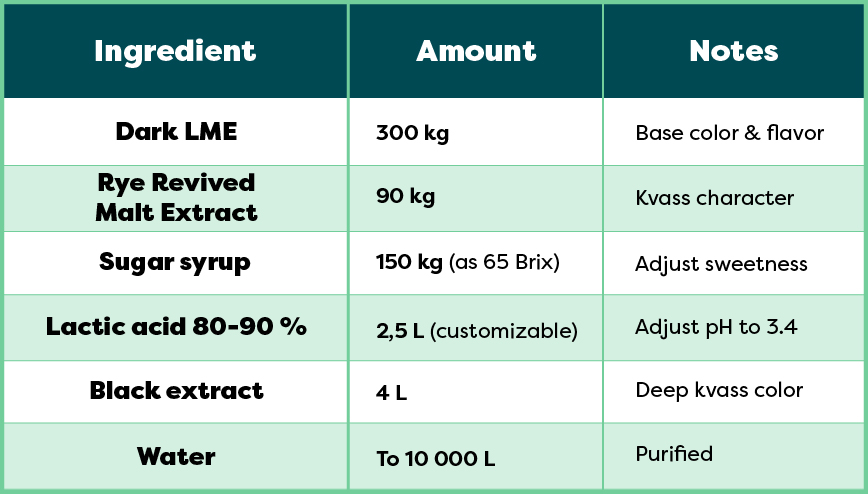
Resulting specs:
• °P: ~5.0
• pH: 3.4
• CO₂: 5 g/L
• ABV: <0.05% (no fermentation)
• Shelf life: 6–12 months (pasteurized)